
Svenska Dagbladet Näringsliv – Så ska britternas ‘andra vardagsrum’ räddas.
Written by Charlotta Buxton, published on Wednesday 2nd August 2023.
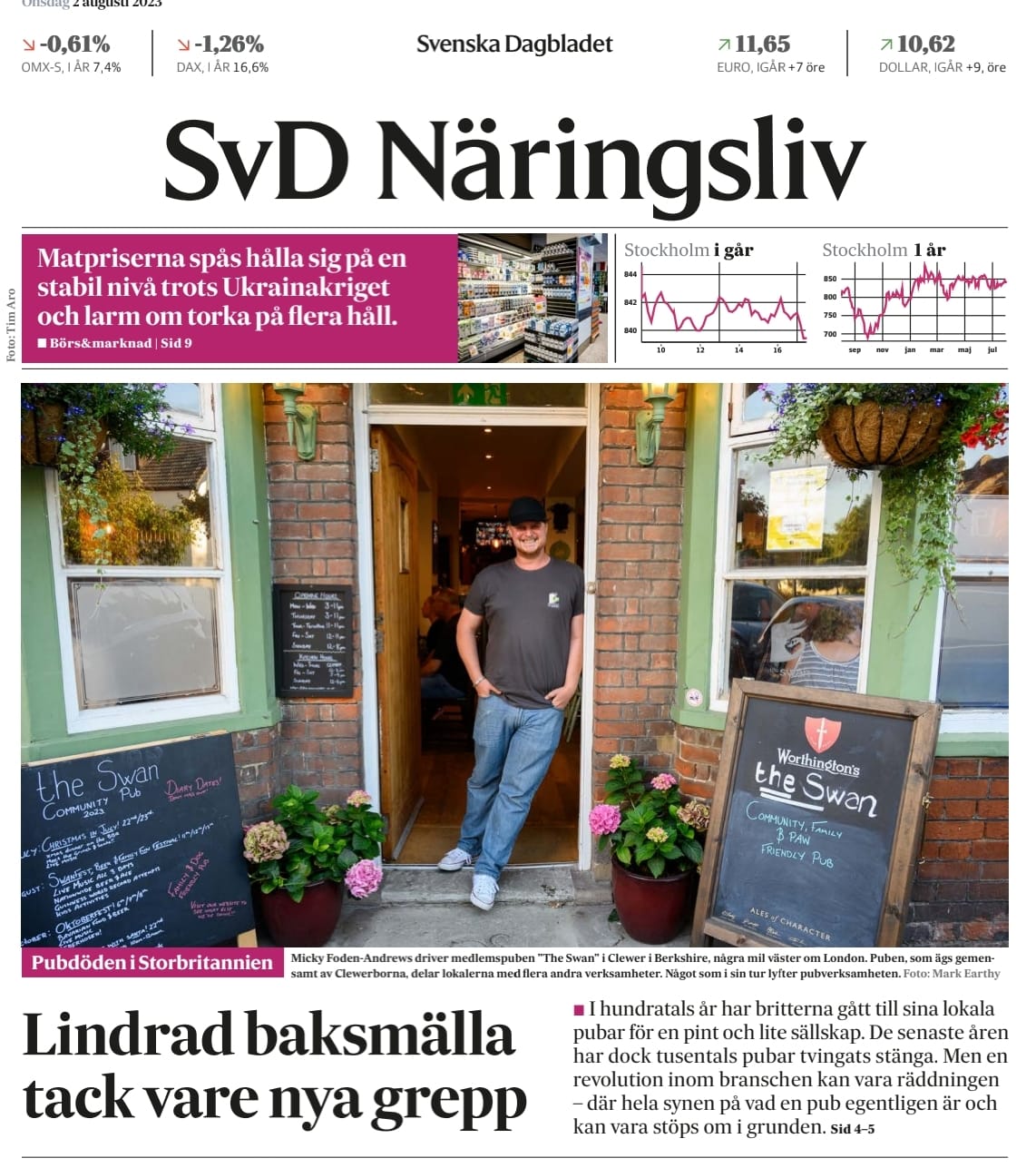
Roughly translated … “This is how the British ‘second living room‘ will be saved. Now a record number of pubs are closing – the British ‘second living room‘ is facing a historic crisis. But there is a solution to save the pubs. The method, which has been described as ‘fantastic’, has now become widespread.”
Hej! Some quick background on this pretty unique story. Dave behind the bar took a call from a ‘famous’ Swedish newspaper. They had learned about Christmas in July and other community activities that are run at The Swan. From that, Mark, a photographer, arranged to come in during one of our quiz nights; people might remember seeing him. Charlotta then interviewed Micky over the phone, and this is the result! You can see it online at Svenska Dagbladet. Hälsningar till våra vänner i Sverige!
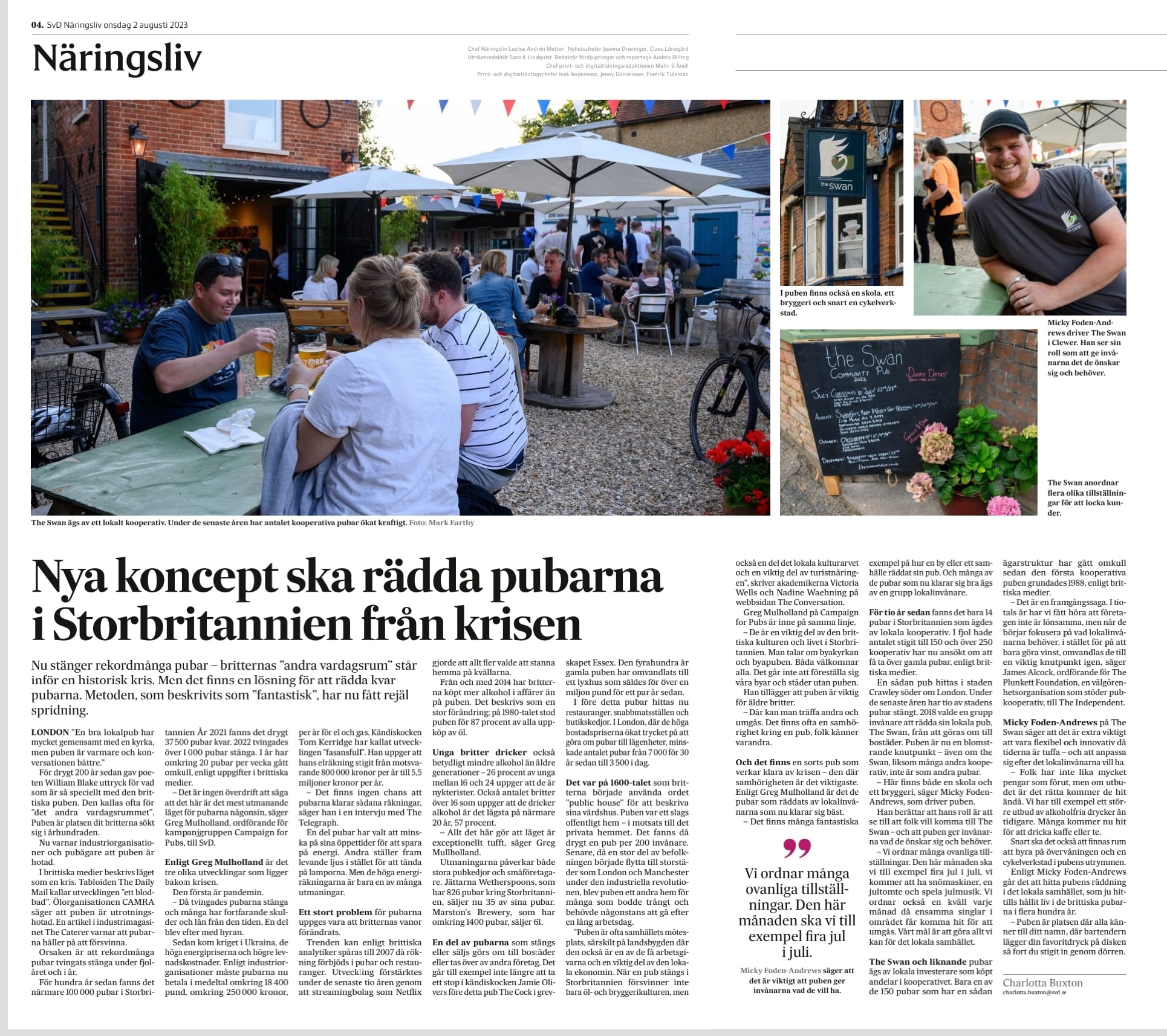
Rough Translation
New concepts will save pubs in the UK from the crisis
A record number of pubs are closing – the British “second living room” is facing a historic crisis. But there is a solution to save the pubs. The method, which has been described as “fantastic”, has now gained widespread popularity.
LONDON: “A good local pub has a lot in common with a church, but the pub is warmer, and the conversation is better.
Over 200 years ago, the poet William Blake expressed what is so special about the British. It is often called the “second living room”. The pub is the place where the British have been for centuries.
Now industry organisations and pub owners are warning that the pub is under threat.
The British media is describing the situation as a crisis. The Daily Mail tabloid calls the development “a bloodbath,” and the beer organisation CAMRA says the pub is on the verge of extinction. An article in industry magazine The Caterer warns that pubs are disappearing. The reason is that a record number of pubs have been forced to close last year and this year.
A hundred years ago there were nearly 100,000 pubs in Great Britain tannien in 2021, there were just over 37,500 pubs left. In 2022, over 1,000 pubs were forced to close. This year, around 20 pubs per week have gone bankrupt, according to data in the UK media. It is no exaggeration to say that this is the most challenging situation for pubs ever, says Greg Mulholland, chairman of the campaign group Campaign for Pubs to SvD.
According to Greg Mulholland, there are three different developments behind the crisis:
- The first is the pandemic.
- Then the pubs were forced to close, and many still have debts from that time. Some fell behind with the rent.
- Then came the war in Ukraine, high energy prices and higher living costs.
According to industry organisations, pubs now have to pay an average of around £18,400, around SEK 250,000 per year, for electricity and gas. Celebrity chef Tom Kerridge has called the development “horrific. He states that his electricity bill has risen from the equivalent of 800,000 kronor per year to 5.5 million kronor per year.
There is no chance the pubs can handle such huge bills, he says in an interview with the Telegraph.
Some pubs have reduced their opening hours to save energy. Others are lighting candles instead of lights. But the high energy bills of many pubs are a challenge.As of 2014, Britons have been buying more alcohol in shops than in pubs. This is described as a major change; in the 1980s, pubs accounted for 87 per cent of all beer purchases.
A big problem for the pubs is said to be the British. ChangedAccording to British analysts, the trend can be traced back to 2007, when smoking was banned in pubs and restaurants. The development has been reinforced over the past ten years by streaming companies such as Netflix.
Young Britons also drink significantly less alcohol than older generations – 26 per cent of 16-24 year-olds say they are teetotal. The number of Britons over 16 who say they drink alcohol is also the lowest in nearly 20 years, 57 percent. All of this makes the situation exceptionally tough, says Greg Mullholland.
The challenges affect both large pubs and small businesses. Wetherspoons, which has 826 pubs across the UK, is now selling 35 of its pubs, while Marston’s Brewery, which has around 1,400 pubs, is selling 61.
Some of the pubs that are closing or being sold are being converted into housing or taken over by other businesses. For example, you can no longer stop by celebrity chef Jamie Oliver’s former pub The Cock in Count. The four-hundred-year-old pub has been converted into a luxury home that sold for a million pounds a couple of years ago. Former pubs now house restaurants, fast food outlets and chain stores. In London, where high house prices have increased pressure to convert pubs into apartments, the number of pubs has fallen from 7,000 30 years ago to 3,500 today.
It was in the 17th century that the British began to use the word “public house” to describe their inns. The pub was a kind of public home, akin to the private home. As part of the population began to move to big cities like London and Manchester during the Industrial Revolution, the pub became a second home for many who lived in cramped conditions and needed somewhere to go after work.
“The pub is often the meeting place of the community, especially in rural areas where it is also one of the few employers and an important part of the local economy. When a pub closes in the UK, its beer and brewery culture does not disappear; there are examples of how a village or community has saved its pub. And many of the pubs that are now doing well are owned by a group of local residents.
In the Pahen brewery town, there is also a school and a bicycle factory. “It is also part of the local cultural heritage and an important part of the tourism industry,” write academics Victoria Wells and Nadine Wachming on The Conversation website.
Greg Mulholland of Campaign Pubs agrees. They are an important part of British culture and life in Great Britain. People talk about the village church and the village pub. Both welcome everyone. It is impossible to imagine our villages and towns without the pub. He adds that the pub is important for older Britons. There you can meet others and socialise. There is often a sense of togetherness around a pub; people know each other.
And there is a kind of pub that seems to be surviving the crisis – that sense of belonging is the most important thing. According to Greg Mulholland, it is the pubs that have been saved by the locals that are now doing the best. Ten years ago, there were only 14 pubs in the UK owned by local cooperatives. Last year, the number had risen to 150, and over 250 cooperatives have now applied to take over old pubs, according to British media.
One such pub is found in the town of Crawley, south of London. In recent years, ten of the town’s pubs have closed. In 2018, a group of benefactors chose to save their local pub, The Swan, from being turned into housing. The pub is now a thriving hub – even the Swan, like many others, is not like other pubs. Here there is both a school and a brewery, says Micky Foden-Andrews, who runs the pub. He says his role is to make sure people want to come to The Swan – and that the pub gives residents what they want and need.
We arrange a lot of unusual events. This month, for example, we will be celebrating Christmas in July. We will have snow machines, Santa Claus and play Christmas music. We also organise an evening every month when lonely singles in the area can come here to socialise. Our goal is to do everything we can for the community.
The Swan and similar pubs are owned by local investors who have bought shares in the cooperative. Just one of 150 pubs. It’s a success story. For decades we’ve been told that businesses aren’t profitable, but when they start focusing on what local people need, rather than just making a profit, they become a vital hub again,” James Alcock, chairman of The Plunkett Foundation, a charity that supports pub cooperatives, told The Independent.
Micky Foden-Andrews at The Swan says it’s extra important to be flexible and innovative when times are tough – and to adapt to what locals want. People have as much money as before, but if it’s the right thing to do, they’ll still come here. For example, we have a wider range of non-alcoholic drinks than before. Many people now come for coffee or tea.
Soon there will also be space for rent upstairs and a bicycle repair shop in the pub’s premises. According to Micky Foden-Andrews, the pub’s salvation can be found in the local community, which has kept British pubs alive for hundreds of years.
“The pub is the place where everyone knows your name, where the bartender puts your favourite drink on the counter as soon as you walk through the door.”
Charlotte Buxton